
Not all radial pistons are
Built the same.
You’ve been specifying radial piston motors for years. But have you ever opened one and looked at the piston cross-section?
Welcome back to the THOTH Hydraulics newsletter. Last issue, we walked through when to choose an orbital motor versus a radial piston motor — and why the answer depends on your operating profile, not the catalog.
This time we go one level deeper: inside the radial piston motor itself. Two motors can share the same frame, the same port layout, the same mounting pattern — and still deliver fundamentally different performance. The difference is in the piston geometry.

Two radial piston motors, nearly identical externally. One is rated to a maximum differential pressure of 450 bar. The other to 400 bar — but with significantly higher displacement from the same envelope.
The spec sheet doesn’t explain why. The answer becomes visible only when you open the motor and look at the piston cross-section.
How a multi-stroke radial piston motor works
A radial piston motor arranges its pistons radially around a central shaft. Each piston carries a roller at its tip, and those rollers ride along the internal surface of a cam ring — a precisely machined component with a wave-like profile. Three components define the system.
The rotating body that houses the pistons and distributes hydraulic fluid through internal porting.
The working pair. Pressure pushes the piston out; the roller transfers that force to the cam surface, generating rotation.
The stationary ring with an undulating profile. Each piston follows its peaks and valleys, reciprocating several times per revolution.
This is the multi-stroke principle. Where an orbital motor’s rotor completes one reciprocation per revolution, a multi-stroke radial piston motor drives each piston through 5 to 7 strokes per revolution. Torque pulses are distributed more evenly, and low-speed rotation is smoother — often stable below 10 rpm.
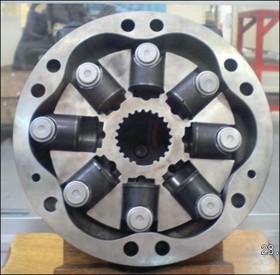
A few micrometres of variation on the cam ring directly set torque ripple and service life.
Two piston designs: cylindrical vs stepped
Within this multi-stroke architecture, the piston itself comes in two fundamentally different geometries — and the cross-section is where the difference lives.
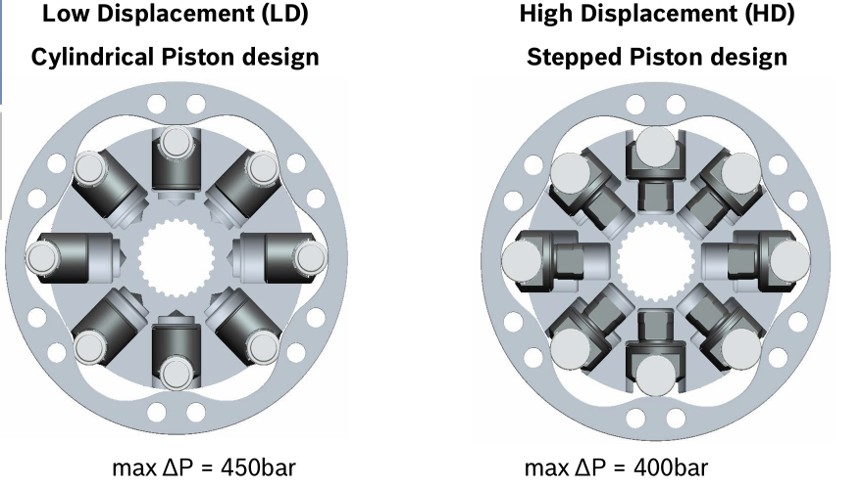
Low displacement, high pressure
A straight cylinder with uniform cross-section. Pressure acts on a single face. Machining tolerances are straightforward, seal contact area is minimal, and leakage paths are well-defined — a design inherently suited to sustained high-pressure operation.
High displacement, high torque density
A stepped profile — a larger diameter at the top transitioning to a smaller diameter below — creates a two-stage effective area. Pressure acts on both the primary face and the annular step, increasing force per stroke for 30–40% more displacement from the same frame.
| Cylindrical (LD) | Stepped (HD) | |
|---|---|---|
| Piston geometry | Uniform cross-section | Two-stage stepped |
| Displacement | Baseline | 30–40% higher (same frame) |
| Max ΔP | ~450 bar | ~400 bar |
| Torque density | Baseline | Higher |
| Structural complexity | Lower | Higher (seal + machining) |
| Leakage sensitivity | Lower | Higher (oil management ↑) |
| Getting more torque from the same envelope is not free — the pressure rating and maintenance requirements shift with it. | ||
Where each design belongs
Piston geometry selection isn’t a spec-sheet exercise. It comes down to three operating conditions.
Is installation space the hard constraint?
If the required torque must come from a smaller motor, Stepped (HD) is the answer. Higher displacement from the same frame lets the gearbox ratio shrink — or the gearbox disappear. Crawler travel drives, compact winches, drives buried inside enclosed frames: anywhere the envelope is the limit.
Does the system run continuously above 420 bar?
If yes, Cylindrical (LD) is safer. A 450 bar continuous rating leaves adequate margin at an actual 380–420 bar for pressure spikes, thermal variation, and long-term seal integrity. Matching that margin with a 400 bar Stepped motor is difficult in practice.
What is the realistic oil cleanliness on site?
Stepped pistons have more seal contact area and tighter clearances — ISO 4406 / NAS Class 7 or better is effectively mandatory. On a mine site, a ship deck, or a concrete batching plant, where contamination control is structurally hard, Cylindrical offers more forgiving service life.
Two selection cases from the field
Crawler travel drive
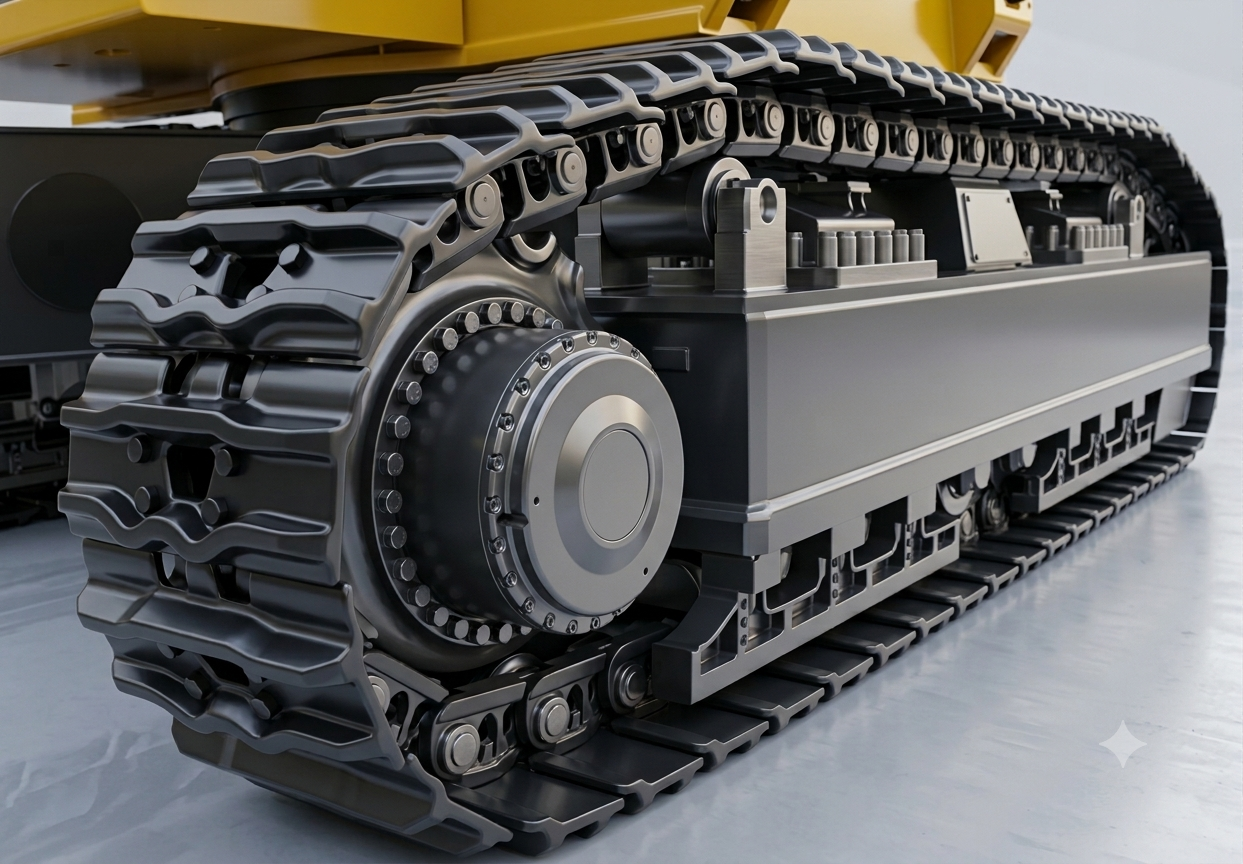
The crawler frame leaves no room for an oversized motor — a Cylindrical motor of equivalent torque would need the next frame size up, which physically doesn’t fit. The Stepped piston met the torque within the existing envelope. Oil cleanliness held at NAS Class 7 through the OEM’s centralised filtration.
Marine winch drive
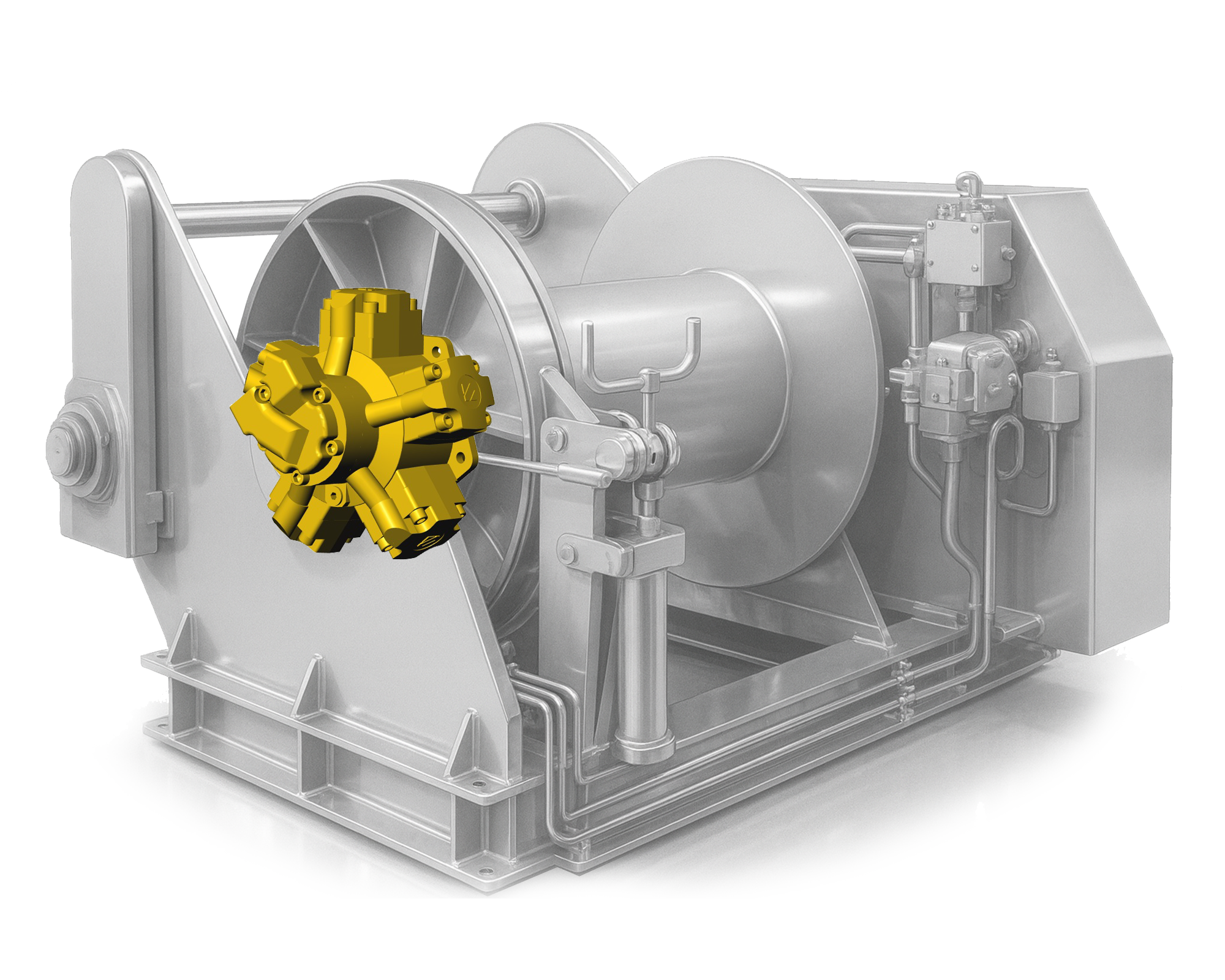
Winch drives run at high pressure for long durations; salt spray, vibration and difficult access make contamination a persistent risk. Space was generous — stepping up one frame size was feasible. The Cylindrical motor’s 450 bar rating gave margin above operating pressure, and its simpler seal arrangement held up better under challenging oil conditions.
Three engineering tips from the field
Monitor cam ring wear through oil analysis
Stepped pistons apply higher unit loads to the cam surface. Track iron particle concentration (Fe ppm) over time — a rising trend signals cam ring wear before any performance symptom appears. The oil data warns you; the teardown confirms it.
Record case drain flow at commissioning
HD motors have structurally higher internal leakage than LD. The case drain flow recorded at commissioning is the only reference that makes later condition assessment possible. Without a baseline, “normal for this motor” versus “developing failure” is guesswork.
Replace pistons and rollers as a set
The piston and its roller are a matched wear pair. Reusing the original roller with a new piston creates a contact-area mismatch — localised stress rises and the replacement fails early. Even when the manual doesn’t say so, treat them as a set.
Not better or worse — where.
Cylindrical (LD): when pressure margin matters, when oil conditions are difficult, when structural simplicity lowers long-term maintenance cost.
Stepped (HD): when installation space is the hard limit, when torque density must be maximised from a given frame, when oil-management infrastructure is in place.
Both share the advantages of multi-stroke radial piston architecture — torque smoothness, low-speed stability, long service life. The difference is which operating conditions let each design deliver those advantages most reliably.
The spec sheet gives you the numbers. The operating profile gives you the answer.
Specifying a radial piston motor
for a tight envelope or hard duty?
Send us your operating profile — pressure, duty, space, oil environment — and we’ll come back with a cylindrical-or-stepped recommendation, not a product brochure.
An introduction to one of ZI’s newly developed products — a closer look at the engineering behind it and the applications it was designed for.