
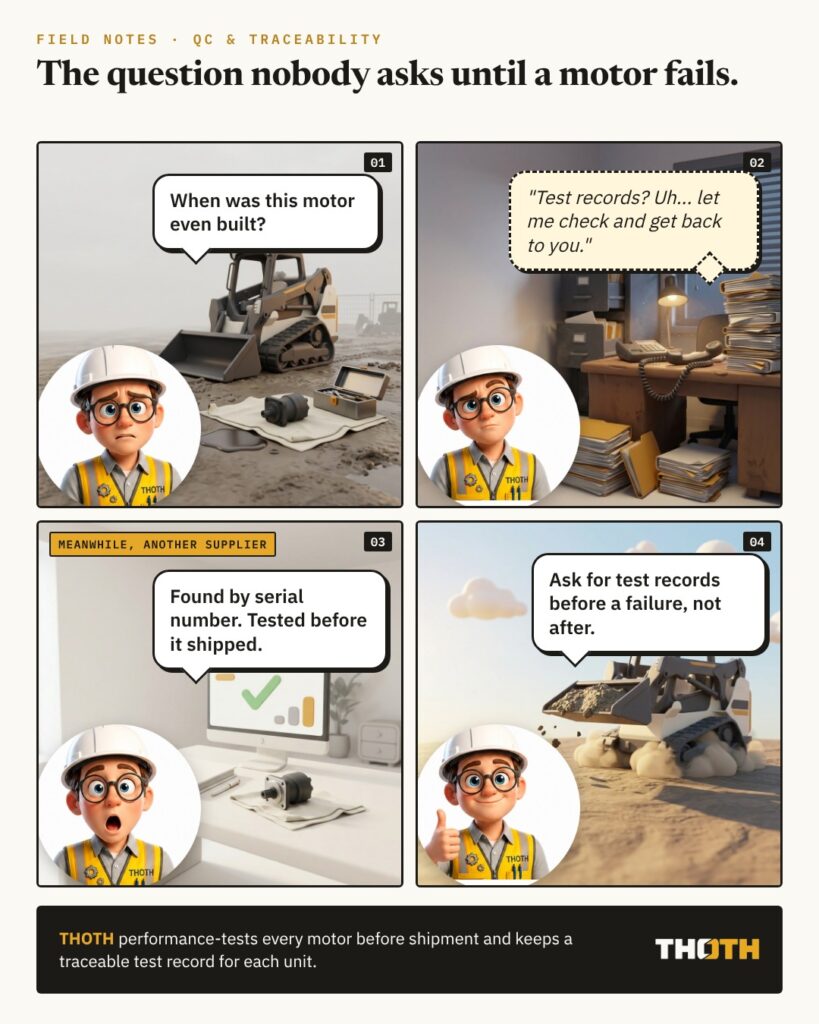
Ask for test records
before a failure, not after.
A per-unit test record, linked to the serial number, is what turns a field failure into a fact-based root-cause analysis. Here is what to ask for, and when.
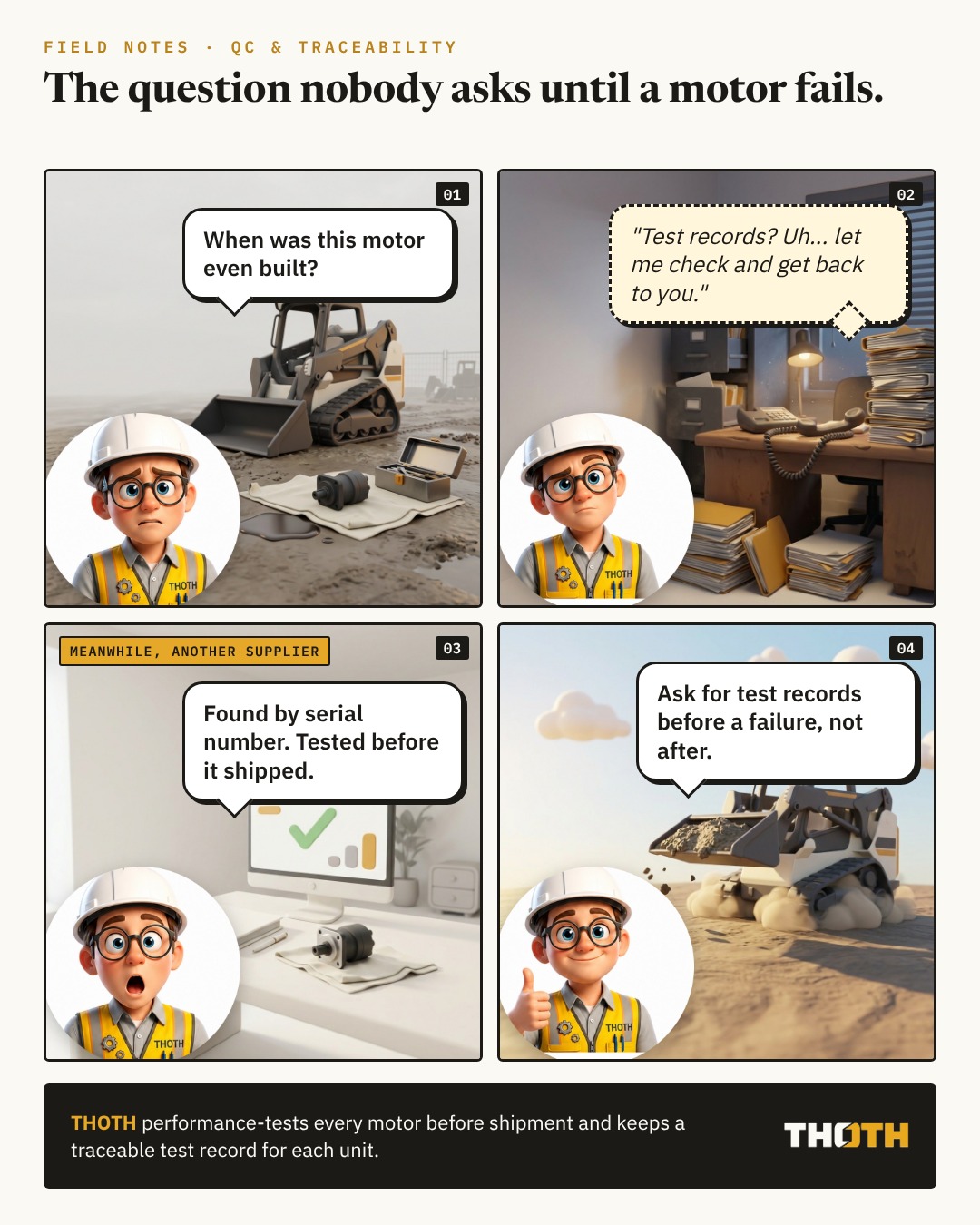
When a hydraulic motor fails in the field, the first two questions are usually the same: when was this unit built, and how was it tested before it left the factory? The answers decide whether the investigation looks at the motor, the installation or the circuit. If the supplier needs days to find them, the root-cause analysis starts with a guess.
What a traceable test record actually contains
A useful pre-shipment record links one serial number to the measured performance of that specific unit, not to a sampling report for the batch. ISO 9001:2015 frames the general requirement: where traceability is a requirement, the organization controls the unique identification of its outputs and retains documented information about them.[1] For hydraulic motors, ISO 4409:2019 describes how steady-state performance and efficiency are tested and presented.[2]
In practice, check that the record shows the test conditions (pressure, flow, oil temperature), the measured result against the acceptance limit, and the date and station where the unit was tested. A record without conditions is hard to compare with what the motor saw in the field.
Three questions to ask before you approve a supplier
- Is every unit performance-tested before shipment, or only samples from each lot?
- Is the test record linked to the serial number on the motor nameplate?
- How quickly can the record be sent when a unit is returned or questioned?
The third question is the one most often skipped, and it is the one that matters during a warranty claim or a line stoppage.
How THOTH handles it
THOTH runs a three-stage inspection flow: incoming parts, in-process inspection, and a 100% final performance test on finished motors, with test data and a final test report kept for each unit.[3] The testing zone of our factory tour shows the benches where this happens.
Common questions
- Is a batch certificate enough for hydraulic motors?
- A batch certificate confirms that a lot met its specification on average. It does not tell you how the individual unit on your machine performed. For failure analysis and warranty decisions, a per-unit record linked to the serial number is far more useful.
- When should I request test records?
- During supplier qualification, before the first production order. Ask for a sample record from a recent shipment and check that it can be matched to a serial number. Requesting it for the first time after a failure is too late to judge the supplier’s system.
Want to see a sample test record?
Send us the model you are evaluating. We will share a sample pre-shipment test record and explain how it is traced to the serial number.
Email sales20@zihyd.com →See the LinkedIn post →- [1]ISO 9001:2015, Quality management systems: Requirements, clause 8.5.2 Identification and traceability. iso.org/standard/62085.html
- [2]ISO 4409:2019, Hydraulic fluid power: Positive-displacement pumps, motors and integral transmissions: Methods of testing and presenting basic steady state performance. iso.org/standard/68410.html
- [3]Ningbo Zhongyi Hydraulic Motor Co., Ltd. (THOTH / ZiHYD), company introduction and quality system documentation, 2025.