
Continuous vs intermittent:
which column to size on.
Continuous, intermittent and peak ratings are not interchangeable, and the difference is time. How to read them, with BM3Y-200 catalog values.
A motor can meet the torque requirement on paper and still fail early, because the number used for sizing came from the wrong column. Most orbital motor catalogs list three ratings for pressure and torque: continuous, intermittent and peak.
What the three columns mean
In the THOTH orbital motor catalog, the definitions apply to every model.[1] Continuous is the value the motor can run at without a time limit. Intermittent is allowed for a maximum of 10% of every minute, which is 6 seconds. Peak is allowed for a maximum of 1% of every minute, which is 0.6 seconds.
Those are the BM3Y-200 values.[1] Designing the running load against 672 N·m would mean asking the motor to spend the whole minute in a condition it is rated for only six seconds of.
Why time is part of the rating
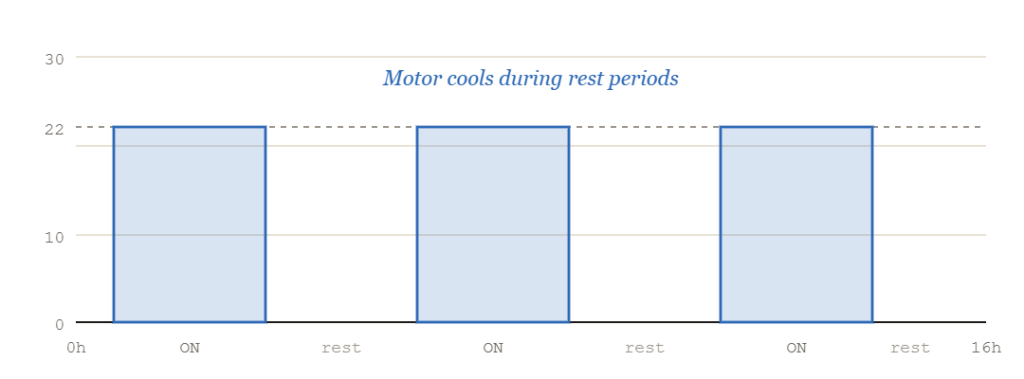
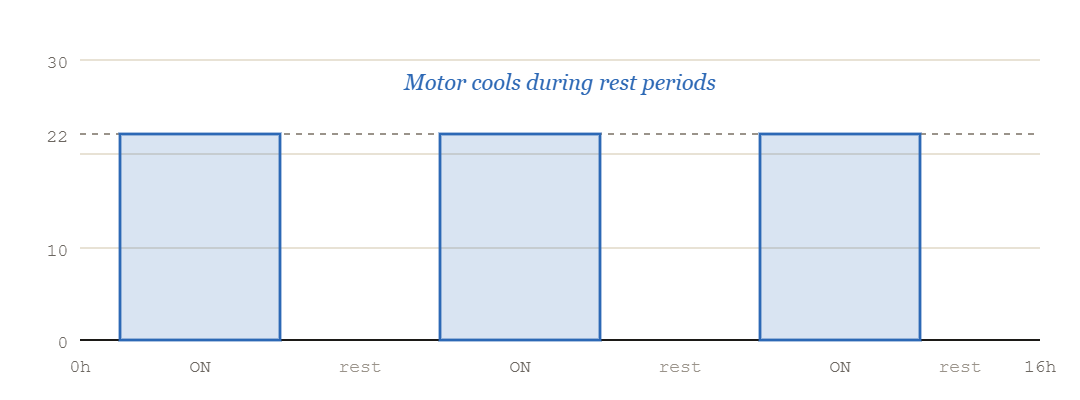
No motor converts hydraulic power into shaft power without losses. Leakage and friction losses become heat in the oil and the housing, and they rise with pressure. Laboratory work on low-speed high-torque gerotor motors tested at 160 to 240 bar shows how strongly total efficiency depends on design details and operating point, and links efficiency directly to friction and wear losses.[2] A short excursion to intermittent pressure is absorbed by the motor and the oil. Holding that pressure continuously keeps the loss rate high without the rest periods the rating assumed.
Catalog performance values are steady-state measurements. ISO 4409:2019 describes how steady-state performance and efficiency are tested and presented for hydraulic motors,[3] which is why they should be read as values at a stated condition, not as limits you can hold indefinitely.
A simple sizing rule
- Map the real duty cycle: length of each on period, rest ratio, and whether the drive ever holds pressure at stall.
- Size the running load against the continuous rating.
- Check that start-up and short overloads fall inside the intermittent rating and its time limit.
- Treat the peak rating as protection margin for pressure spikes, not as a design point.
Common questions
- Can I use the intermittent rating for start-up torque?
- Yes, if the start-up lasts only seconds and repeats within the time limit. Our grain auger sizing guide works through exactly this case.
- Is a larger motor always safer?
- Not always. A larger motor needs more flow for the same speed and adds weight. The goal is a motor whose continuous rating covers the running load with margin, not the biggest size in the range.
Send us your duty cycle.
Running torque, start-up torque, speed, on time and pump flow. We will place the duty point on the performance grid and propose a size.
Email sales20@zihyd.com →Discuss on LinkedIn →- [1]THOTH / ZiHYD, Orbital Motor Catalog, March 2026. Duty definitions and BM3Y technical parameters (pp. 84–86).
- [2]E. Strmčnik and D. Konovšek, “Energy efficiency analysis in mobile hydraulics,” Journal of Energy Technology (JET), vol. 11, no. 4, pp. 19–27, Dec. 2018. PDF
- [3]ISO 4409:2019, Hydraulic fluid power: Positive-displacement pumps, motors and integral transmissions: Methods of testing and presenting basic steady state performance. iso.org/standard/68410.html